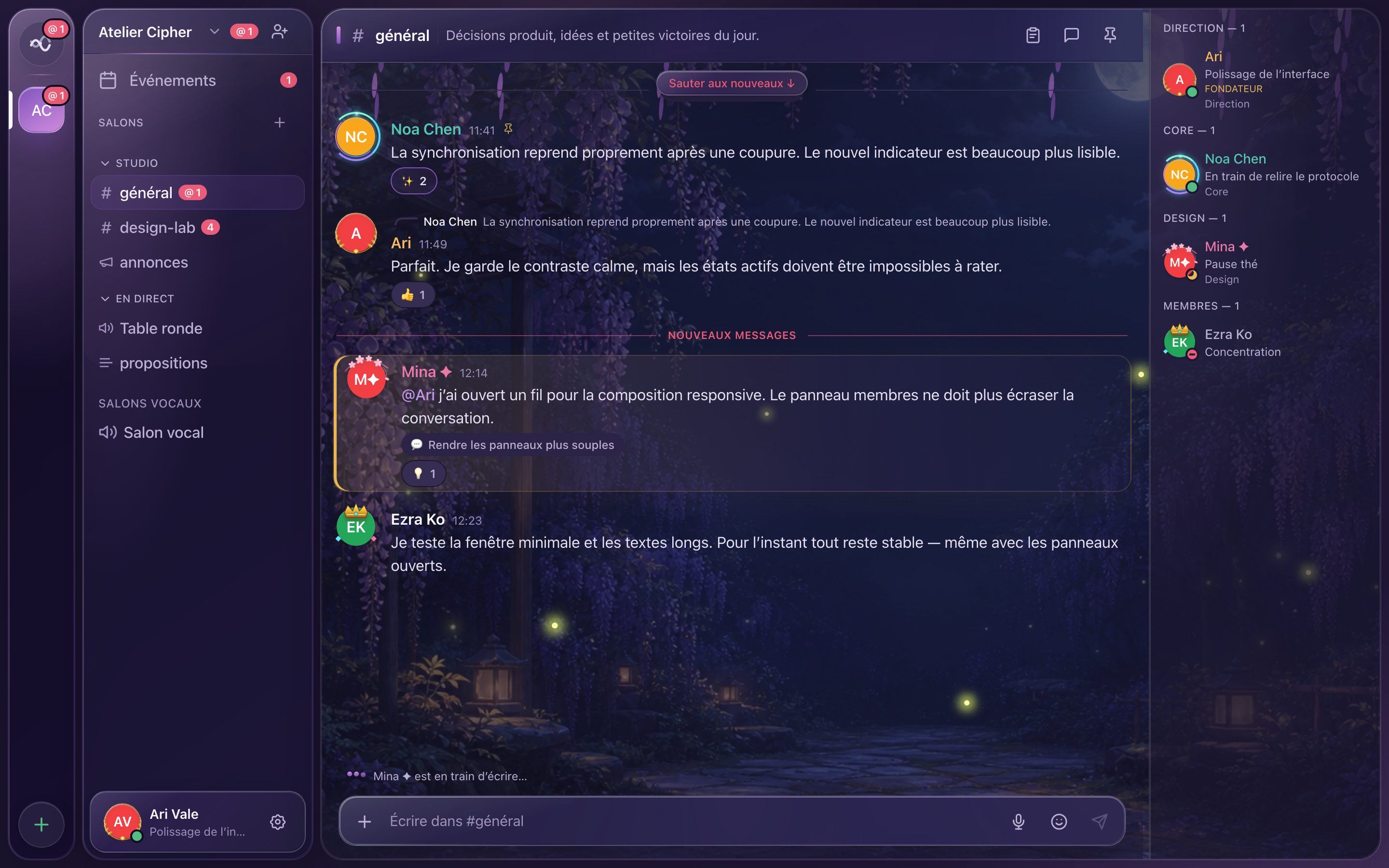
Messages, reactions, threads, replies
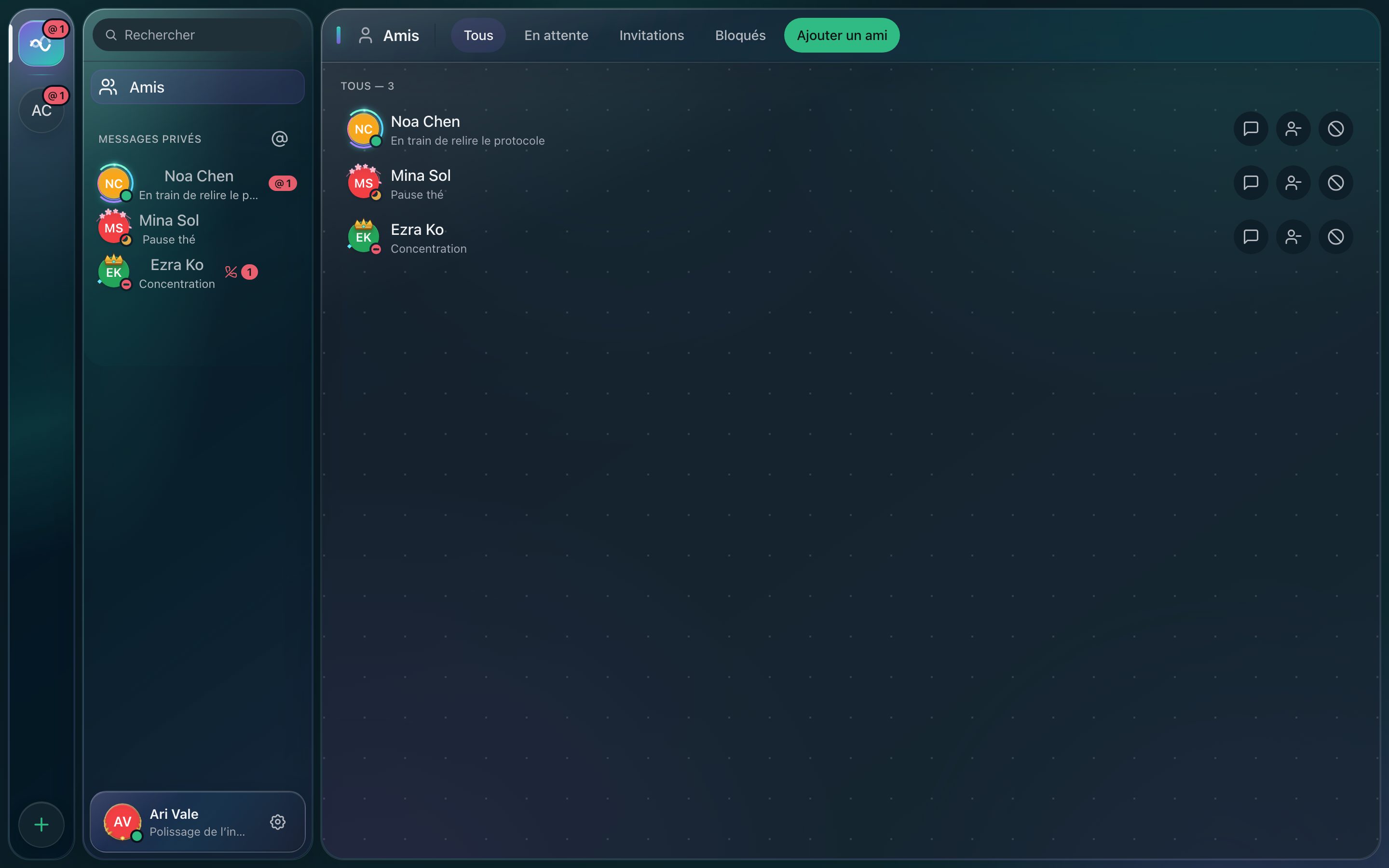
Direct messages and servers with channels, emoji reactions, threads, quoted replies, mentions, pins, polls, instant search across your whole history. Markdown all the way to tables and syntax-highlighted code.
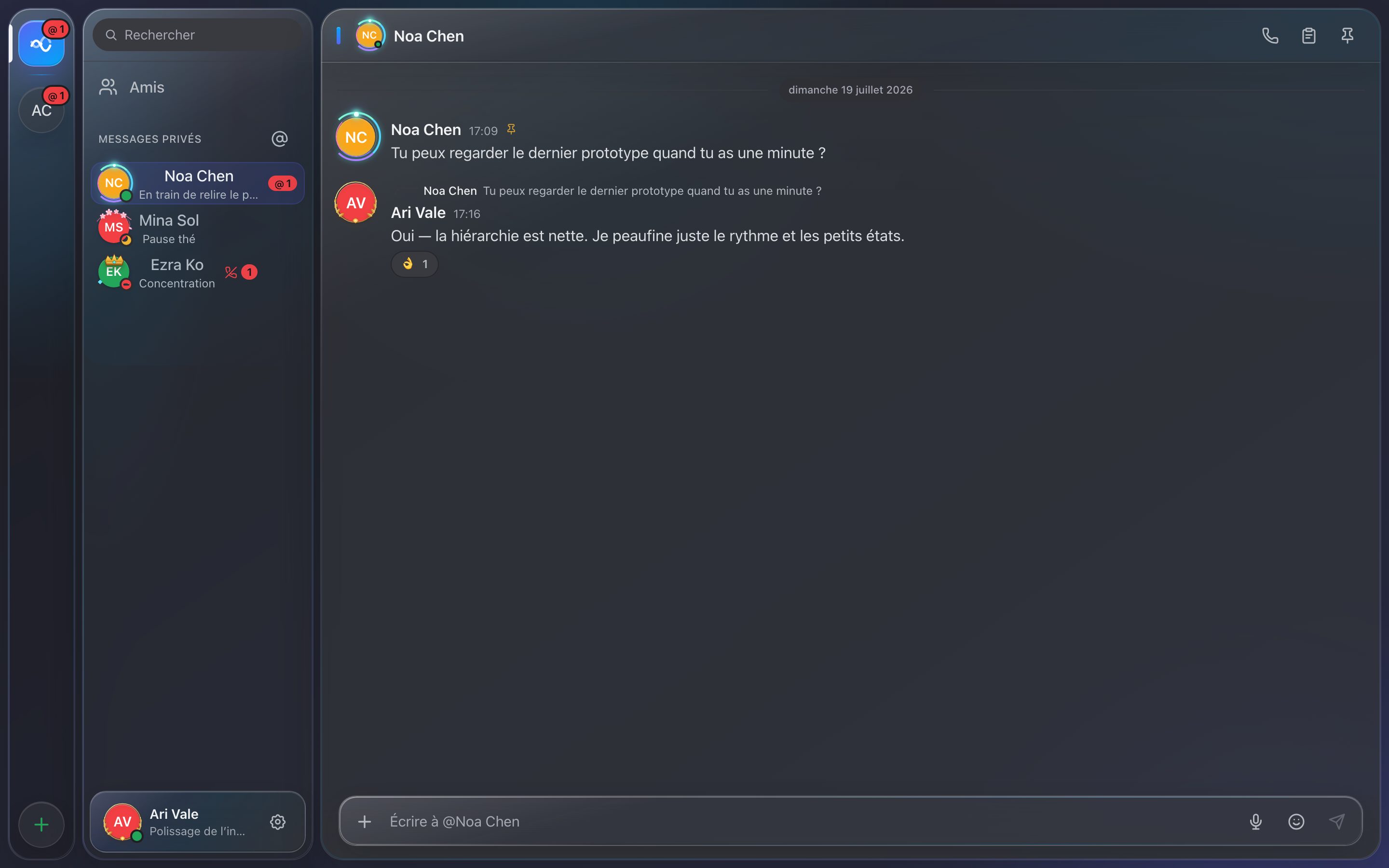
Friends, direct messages, servers, voice channels — and nothing in between. Your messages travel straight from one app to the other. Nobody can host them, read them, sell them or lose them.
Nothing to relearn. Every feature you expect, sitting on an architecture that depends on nobody.
Direct messages and servers with channels, emoji reactions, threads, quoted replies, mentions, pins, polls, instant search across your whole history. Markdown all the way to tables and syntax-highlighted code.
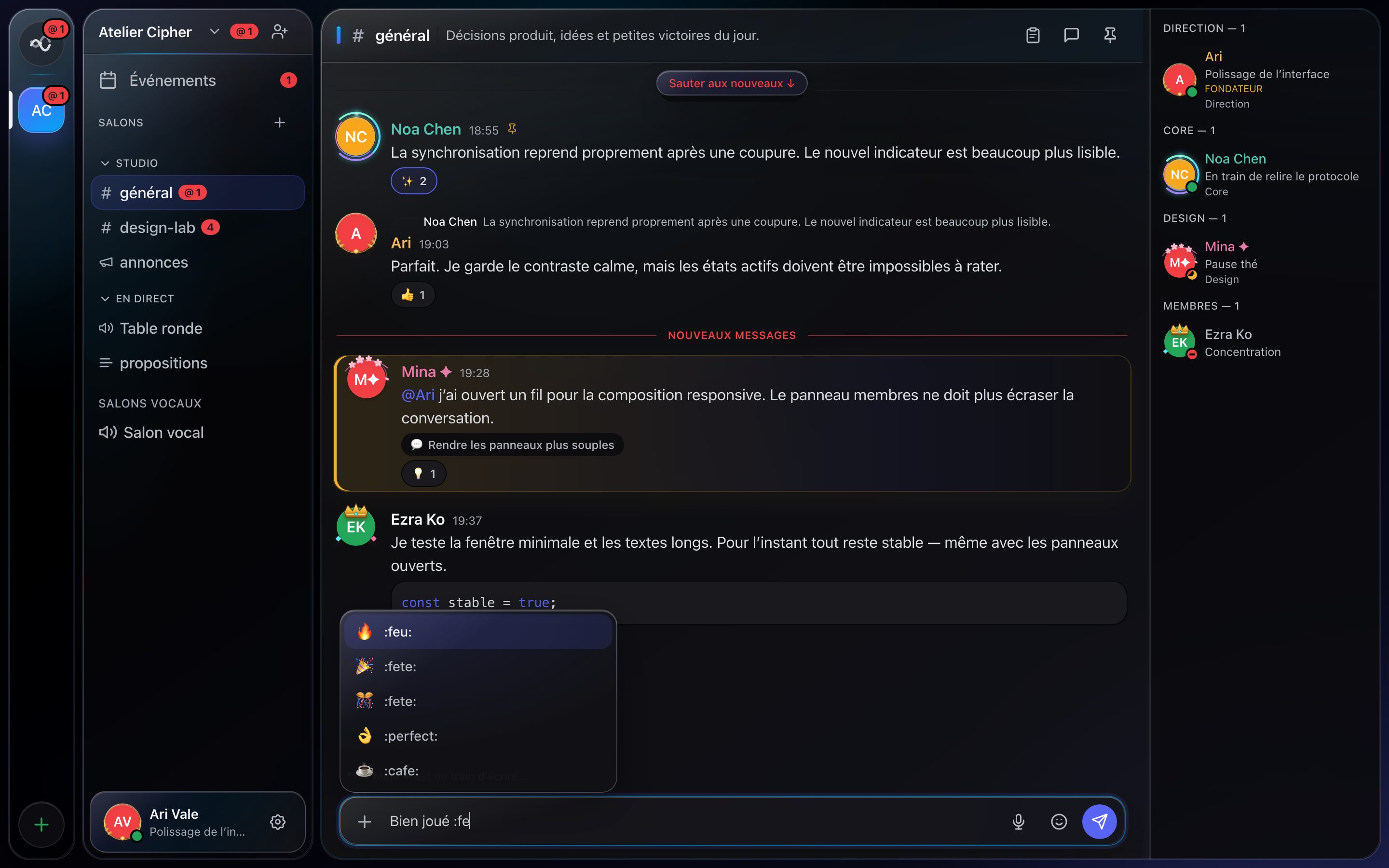
Hit : plus two letters and autocomplete suggests Unicode emojis and your servers' custom emojis. @mentions, quick reactions learned from your habits, drafts kept per conversation — the composer works for you.
Voice channels with echo cancellation, voice mixing and crackle suppression. Per-person volume, push-to-talk.
Drag & drop images and videos, built-in player, previews up to whatever size you choose.
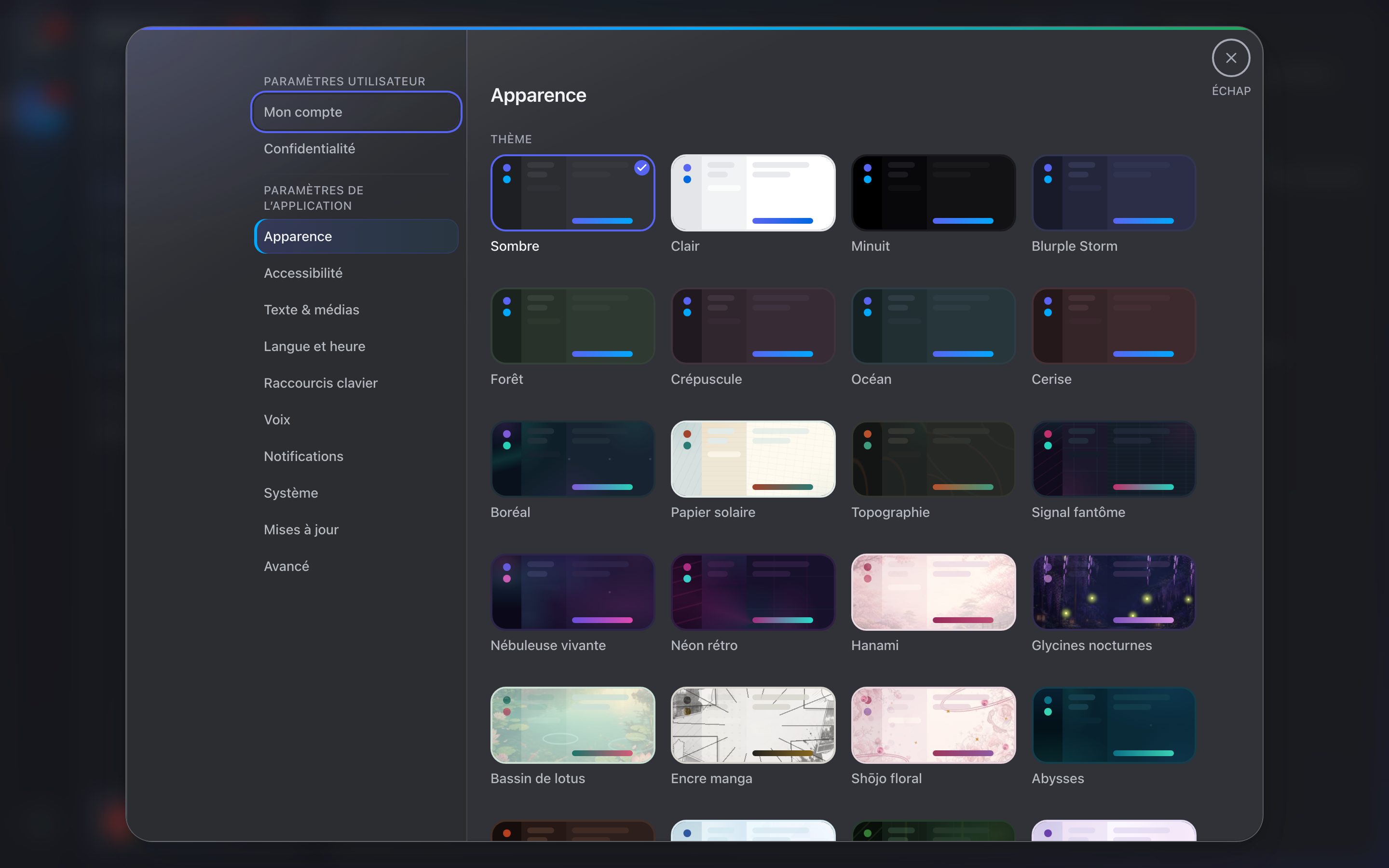
A gallery of themes, including animated worlds, with an adaptive "Liquid Glass" interface.
Fine-grained per-channel permissions, kick, ban, audit log — your servers truly belong to you.
A banner tells you the moment a release ships; one click installs it. Cryptographically signed.
No email, no phone number, no password to remember. Your identity is born on your machine.
Because "free" there means "your conversations live on someone else's computers". Here is what a peer-to-peer architecture changes.
| Accord | Discord | |
|---|---|---|
| Central server | None — peers connect directly | Required, owned by a company |
| End-to-end encrypted messages | ✓ By default, everywhere | ✗ Messages are readable platform-side |
| Account, email, phone | Nothing — a local identity, yours | Account required, personal data attached |
| Your data | At home, only on your machines | On their servers, under their terms |
| Source code | ✓ Open and auditable (MIT) | ✗ Closed |
| Price | Free, no paid tier | Free + a Nitro subscription for the "extras" |
| If the service shuts down | Nothing changes — there is no service | History and communities are gone |
No server to hack, no database to resell, no account to shut down. Your identity fits in a recovery phrase that only you hold.
Really. Peers find each other through a distributed hash table (Kademlia), then connect directly. If a strict firewall blocks the direct path, another peer can relay bytes — end-to-end encrypted, so unreadable to the relay.
Your messages stay on your machine and sync automatically as soon as you are both online. In a server, any connected member is enough to propagate the history.
Yes. No account, no subscription, no ads, no telemetry. The code is MIT-licensed — there is literally no infrastructure to pay for.
Everyone has a short friend code, exchanged once over any channel you like. After that, your apps recognize and find each other on their own. The guide shows it all in pictures.
Your identity fits in a recovery phrase shown when your account is created. Write it down: it lets you restore your identity on a new machine.
Grab the latest release for your system — the download starts right away.
Latest release: v… · published …
First launch: see the setup guide. All builds live on GitHub.
Install Accord, send someone your friend code, and keep your conversations to yourselves. For good.